

Agribusiness Atlas 2026
The European Union (EU) is stepping up efforts to draw in private investment to meet its biodiversity and climate goals. This risks speculation, prioritises profitable projects over vital habitats, and reduces nature to tradable commodities.

Over the last few years, a key pillar of the EU's environmental policy has been to channel financial flows into sustainable activities. This reasoning underpinned the launch of the EU Green Deal and lately the concept of nature credits: tradable units of biodiversity generated through restoration or conservation projects – such as restoring wetlands or planting trees – which corporations can purchase to claim positive action on biodiversity.
Proponents of market-based solutions argue that such approaches can complement existing public budgets for nature and climate protection. However, this claim is highly questionable; nature credits even carry the risk of making the situation worse. First, treating nature as a financial asset undermines its intrinsic value and the unique qualities of ecosystems, which are non-interchangeable and irreplaceable. Placing a monetary value on ecosystems for their ability to store carbon, retain water, or mitigate extreme weather events introduces a market logic, reducing biodiversity to a handful of tradable functions, rather than recognising the full complexity of natural systems. This profit-driven approach allows corporations to claim positive contributions to biodiversity while simultaneously destroying habitats elsewhere through their commercial operations.
Second, creating a new class of financial assets through commodification of nature carries serious risks for land use. The International Advisory Panel on Biodiversity Credits, established by the UK and French governments to promote the integration of biodiversity credits into laws worldwide, has not ruled out secondary market trading, which would allow biodiversity credits to be resold multiple times to profit from price fluctuations. This suggestion is likely to be incorporated into the future EU framework for nature credits. This could introduce a speculative element and greater volatility in these instruments, which in turn is likely to drive up land prices and create uncertainty for biodiversity restoration projects. In the Global South, for example, nature credit projects can result in smallholder farmers, Indigenous Peoples, or local communities losing access to land or natural resources, as corporations purchase the areas for financially lucrative conservation or offsetting initiatives.
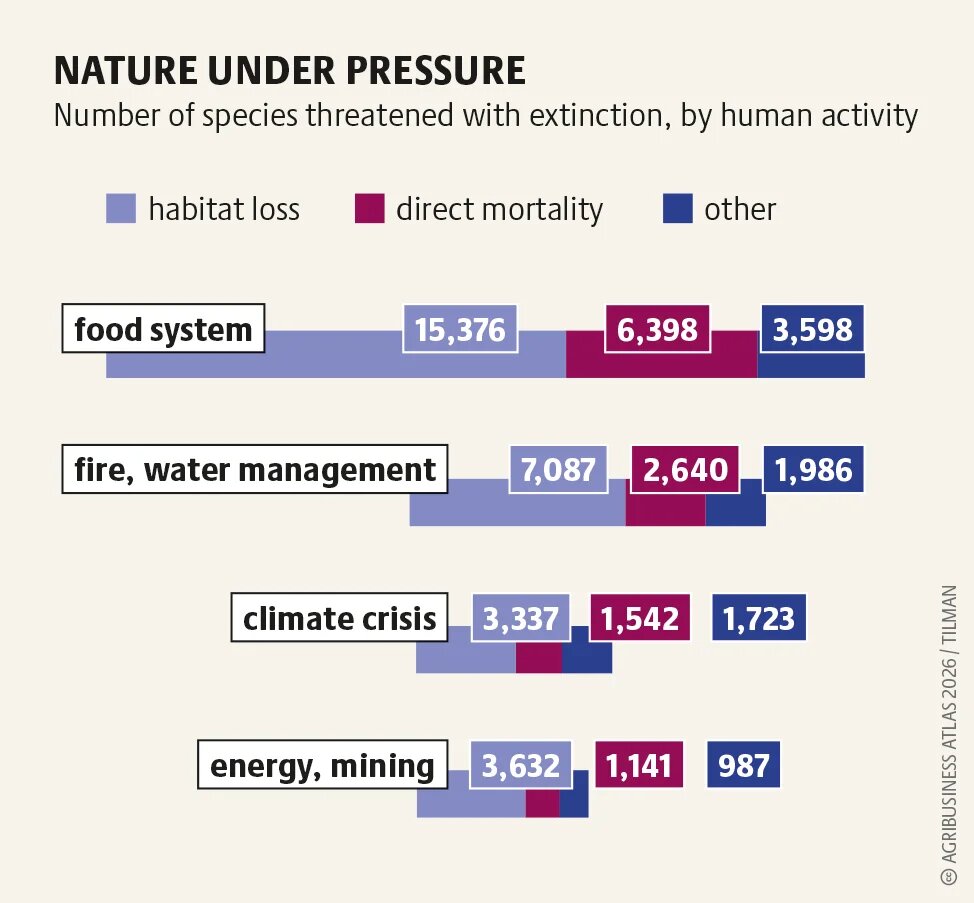
The discussion about nature credits feeds into a narrative that frames the main cause of biodiversity loss as a lack of financing, rather than our current industrial practices, with agribusiness being a major driver of ecological degradation. This narrative diverts attention from the real drivers of today's ecological crisis and allows industries to maintain the status quo and continue with business as usual. No matter how much private or public money is spent on restoration, biodiversity loss cannot be reversed unless we rethink our agricultural system A more biodiversity-friendly food production would require a drastic reduction of pesticide use, more diversity of crops, and the integration of trees and hedges. Legislative efforts must focus on reducing pollution activities and pesticide use, and halting habitat fragmentation and the conversion of natural, agricultural, or forestry land for infrastructure or urban expansion.
Instead of privatising nature restoration, ecosystem restoration and conservation should be treated as public goods. They require long-term planning, a stable and predictable regulatory framework, and inclusive governance. The EU should not abandon its responsibility for protecting ecosystems to private markets, nor transfer environmental decision-making to market forces, which will inevitably prioritise short-term profits over long-term ecological integrity.
The EU could strengthen public financing through dedicated environmental taxes, levies on polluting industries, such as the agrochemical industry, and the redirection of environmentally harmful subsidies. Such funding streams would represent an equivalent cost for corporations, but would keep decision-making in the public sphere, where democratic oversight is possible and ecological priorities can be set based on science rather than financial returns. While seeking funds for restoration is important, the primary focus should be on strong, binding regulations and their enforcement to ensure that corporations actually reduce their environmental impact. This approach would help prevent initial habitat destruction, reducing the need for later restoration. Beyond traditional fiscal tools, innovative governance models such as citizensÕ assemblies could be used to deliberate on restoration priorities and funding sources, ensuring that projects reflect the public interest. In this way, biodiversity restoration can be pursued not as a speculative asset class, but as a shared societal commitment, grounded in democratic legitimacy and ecological responsibility.

A handful of corporations dominate our food system, setting prices, profiting from crises, and driving relentless pressure on the environment, farmers, and consumers alike. The Agribusiness Atlas 2026 traces how this concentration of power took hold, and charts the political pathways toward a fairer food system built around the common good.
